
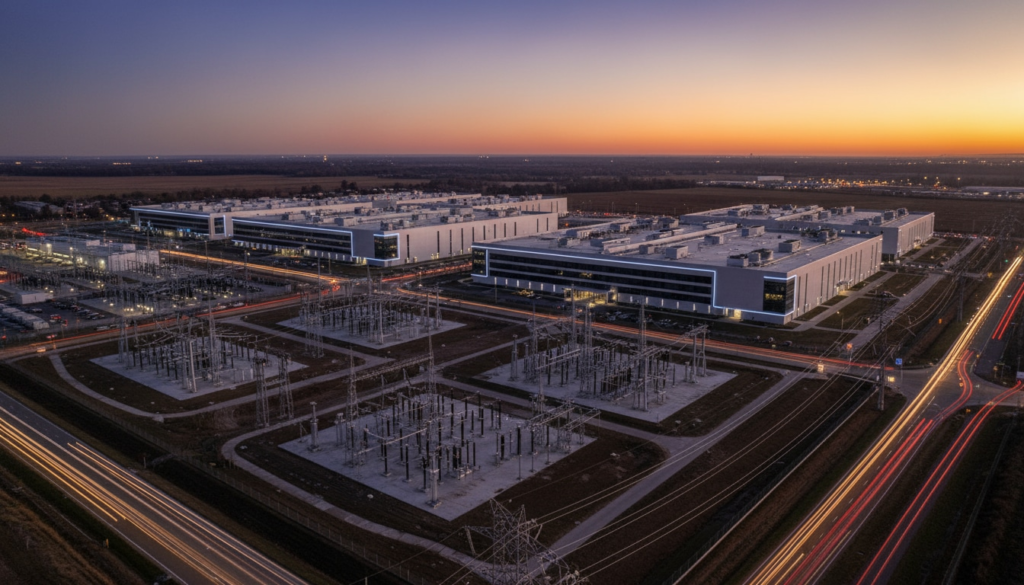
Artificial intelligence may operate through software, but it depends on physical infrastructure.
Behind every expanding computing network are buildings, electrical systems, cooling equipment, and connections to the power grid. That makes AI data center construction a real estate story as well as a technology story.
For developers, contractors, and property owners, the opportunity extends beyond providing space. It involves delivering locations that can support demanding infrastructure requirements.
A Source of Demand in an Uneven Construction Market
The broader construction market provides important context.
In its October 1 release, the U.S. Census Bureau estimated that August 2026 construction spending was 1.7% below August 2025. Spending during the first eight months of 2026 was 3.1% below the same period a year earlier.
The monthly estimate increased, but its reported margin of error means that increase was not statistically conclusive. These figures also describe total construction spending—not the contribution from AI alone. census.gov
Against that backdrop, AI infrastructure represents a distinct source of investment. Its expansion should be evaluated separately from conditions in residential construction, retail development, or other property sectors.
Why AI Data Center Construction Depends on Infrastructure
A data center needs more than a suitable building shell. Its operations depend on reliable electricity, cooling capacity, connectivity, and equipment that can be installed and maintained at scale.
Bank of America Institute’s August 2026 analysis identifies power, labor, and supply chains as constraints that may increasingly determine the pace of AI infrastructure expansion. institute.bankofamerica.com
That changes how a potential site should be evaluated. Available acreage and an attractive purchase price are only the beginning. The more useful questions include:
- What power capacity can actually be delivered?
- What utility upgrades would be required?
- How long could connections and approvals take?
- Can the site support the proposed cooling and equipment systems?
- Does the development schedule align with the intended customer’s needs?
These are due-diligence questions, rather than assumptions that can be resolved by a listing description.
Power Availability Can Change the Real Estate Equation
For many property types, location is evaluated through access to customers, workers, transportation, and surrounding amenities.
A data center introduces another critical consideration: whether the site’s infrastructure can support the proposed use within a workable schedule.
The implication for real estate is that two apparently similar parcels may have very different development prospects. A site requiring extensive infrastructure work may carry costs and timing challenges that are not obvious from its size or zoning alone.
This does not make every industrial property a data center candidate. It makes early infrastructure investigation essential.
Investment Must Translate into Operating Value
Building capacity is one step. Securing a viable customer, completing the facility, and operating it successfully are separate challenges.
Bank of America Institute describes a more selective investment environment, with greater attention to project economics, monetization, and evidence of future returns. Its analysis emphasizes that sustained value will depend on what the spending ultimately produces. institute.bankofamerica.com
For property owners and developers, the practical response is to evaluate the full project rather than rely on the strength of the AI headline. Infrastructure commitments, development costs, customer requirements, and delivery timing need to work together.
What This Means for Southern California Real Estate
The national AI buildout offers a useful lens for examining specialized commercial property demand. It does not establish that every Southern California industrial site will benefit—or that nearby residential values will rise.
A local opportunity needs local evidence: a credible proposed use, confirmed infrastructure requirements, a feasible approval path, and a realistic development budget.
AI’s physical footprint is making those questions increasingly relevant. The real estate opportunity lies where demand for computing capacity can be converted into a facility that can actually be built, powered, and operated.